
|
|
|
|
|
|
This article may be reprinted free of charge provided 1) that there is clear attribution to the Orthomolecular Medicine News Service, and 2) that both the OMNS free subscription link http://orthomolecular.org/subscribe.html and also the OMNS archive link http://orthomolecular.org/resources/omns/index.shtml are included.
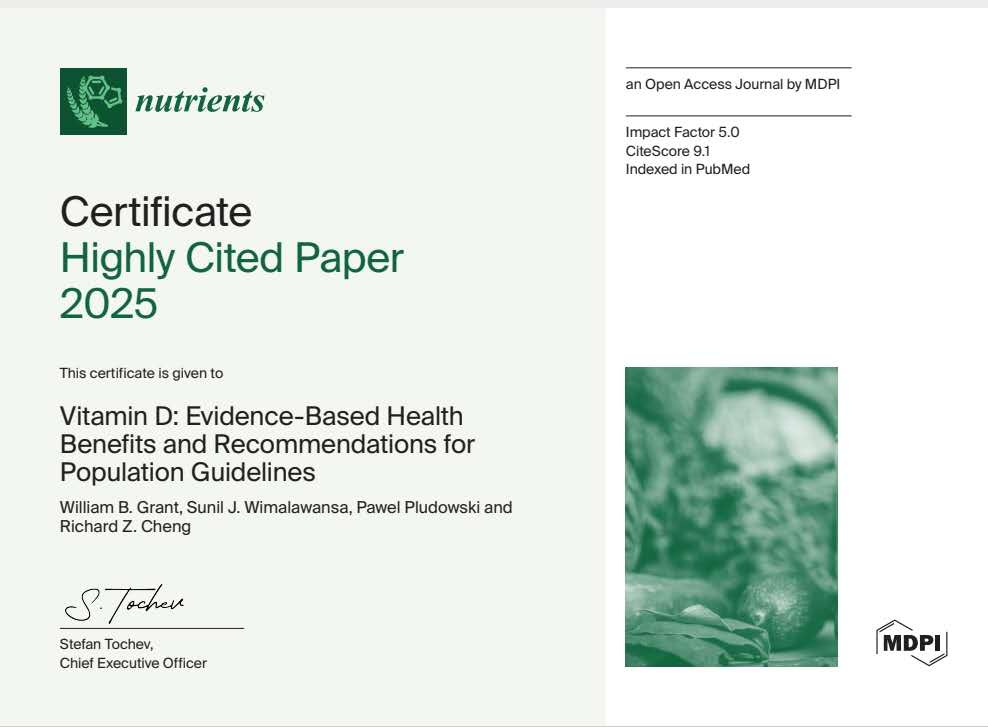
Top Vitamin D Papers Published in 2025: Moving towards using observational studies as the basis for vitamin D recommendationsby William B. Grant Editor's NoteThe article below follows the publication of our Vitamin D: Evidence-Based Health Benefits and Recommendations for Population Guidelines [Grant et al., 2025 (1)]. which was recognized as the most cited paper published in Nutrients in 2025. As of 2025, the paper has received 60 citations in Scopus and 95 citations in Google Scholar, making it the highest-cited vitamin D paper published in 2025 across all journals. This citation performance reflects its substantial impact on ongoing scientific discussions-particularly regarding the appropriate roles of observational studies and randomized controlled trials in informing vitamin D guidelines and public-health policy. The present commentary builds upon this evolving evidence base and places recent vitamin D research developments in a broader methodological and public-health context. - Richard Z. Cheng, M.D., Ph.D.
In 2025, vitamin D policies may have begun relying more on observational studies instead of randomized clinical trials (RCTs), which is a significant and right step forward. The most cited paper of the year highlighted that higher 25-hydroxyvitamin D [25(OH)D] levels are linked to lower risks of incidence or death from eight of the ten leading causes of death in the U.S.: cancer, COVID-19, stroke, chronic lower respiratory diseases, Alzheimer's disease and other dementias, diabetes mellitus, and kidney disease (1). This research and update (2) responded to the 2024 Endocrine Society's guideline, which mainly considered RCTs and recommended 600-800 IU/day for certain age groups―those pregnant, or with high-risk prediabetes. (3) That guideline was based on a narrow review of vitamin D RCTs focusing only on bone mineralization and/or rickets (3). Grant and colleagues (1) noted that 2000 IU vitamin D supplementation could achieve 25(OH)D concentrations >30 ng/mL (75 nmol/L) but that it would take "a daily dose between 4000 and 6000 IU of vitamin D3 needed to achieve serum 25(OH)D levels between 40 and 70 ng/mL and would provide greater protection against many adverse health outcomes." However, this contrasts with earlier guidelines from the same organization suggesting 1500-2000 IU/day for deficiency (4), a step taken backwards. Since the original Endocrine Society Guidelines in 2011, (4) 52,259 vitamin D publications have been published, which the new guideline ignored. In contrast, recent findings indicate 4000-6000 IU/day is needed to increase 25(OH)D levels optimally in a non-obese person, for better health protection. Obese persons would require higher doses. Nearly all vitamin D RCTs have been conducted based on guidelines developed for pharmaceutical drugs, ignoring that vitamin D is a nutrient (5). Based on biology and significant major pharmacokinetic differences, multiple studies have illustrated that RCTs are unsuitable to investigate nutrients (5). Nutrient guidelines should include giving the product to-naïve treatment group a dose of the drug calculated to result in a significantly improved health outcome, not giving the drug to the control group, and analyzing the results in terms of intention to treat. However, traditional vitamin D RCTs include participants often with above-average 25(OH)D concentrations at baseline while also giving or letting the control group take vitamin D (5). Robert Heaney, in 2014, outlined guidelines for RCTs for nutrients (6). Those guidelines were updated for vitamin D in 2017 (7) and reviewed again in 2025 (5). These guidelines include measuring 25(OH)D concentrations for prospective participants and enrolling only those with low concentrations for the health outcome of interest. The vitamin D dose should be large enough to raise 25(OH)D concentrations high enough to significantly reduce adverse health outcomes. Cofactors should be optimized so that the RCT is only sensitive to vitamin D. The results should be analyzed with respect to achieved 25(OH)D concentrations. Very few RCTs have come close to employing these guidelines. Notably, one was for pregnant women in Iran (8), and the other was a secondary analysis of one for progression from prediabetes to diabetes (9). Three reviews published recently outlined how traditional vitamin D RCTs failed (5, 10, 11). A search of pubmed.gov with "vitamin D, randomized controlled trial" published in 2025 found 105 entries. While some had significant positive results, most studies would not be helpful in increasing public interest in vitamin D supplementation. One, a review of vitamin D RCTs for cardiovascular disease (CVD), found "in 14 RCTs with 80,547 participants aged 50-74 years, vitamin D supplementation did not protect against CVD when compared to placebo: risk ratio 1.00 (95 % confidence interval 0.93-1.08) (12). The author concluded, "Overall, the current evidence indicates that vitamin D does not prevent CVD." However, other recent vitamin D reviews related to the cardiovascular system confirmed the beneficial findings (1), (2). It is often stated that observational studies cannot assess causality. This is applicable for pharmaceutical agents, but not for nutrients and nutraceuticals (5). Besides, Hill's criteria for causality in a biological system (13) can indeed assess causality using observational studies. The criteria appropriate for vitamin D include strength of association, consistency of findings, temporality, biological gradient, plausibility (e.g., mechanisms), coherence with the generally known facts regarding the disease, experiment (e.g., vitamin D supplementation studies, whether or not in RCTs), and analogy (13). Recent reviews that assessed causality for vitamin D include one for cardiovascular disease (2) and one for SARS-CoV-2 (14). Novel discoveries related to vitamin D continue to appear in peer-reviewed journals. However, these important findings are rarely published in major medical journals because such journals charge excessive fees, and such articles are rejected by editors due to bias and journals' dependency on pharmaceutical advertising funding. A few of the novel findings regarding vitamin D in 2025 are given here. Novel findings in 2025 An analysis of the benefits of vitamin D in reducing mortality rates based on data from the National Health and Nutrition Examination Survey 2001‒2018 (NHANES 2001‒2018) was published by Chong et al. (15). The database included 47,478 individuals. Significant reductions using date adjusted for 11 factors, including age, BMI, diabetes, hypertension, weak/failing kidneys, and total cholesterol, were found for heart diseases, malignant neoplasms, chronic lower respiratory diseases, influenza and pneumonia, and all other causes. When comparing outcomes for 25(OH)D concentrations greater than 30 ng/mL (75 nmol/L) to concentrations below 20 ng/mL, there were statistically significant reductions in mortality rates associated with nephritis, nephrotic syndrome, and nephrosis were reported (15). Marginally non-significant reductions in mortality were also observed for cerebrovascular disease and diabetes mellitus. These findings provide support for two reviews by Grant and colleagues (1), (2). A related article examined the risk of various health outcomes for 25(OH)D concentrations >75 nmol/L using data from the UK Biobank (16). Authors reported a lower risk of developing non-toxic single thyroid nodule (HR 0.55, 95% CI: 0.38‒0.80), hyperparathyroidism (HR 0.45, 95% CI: 0.24‒0.85), non-insulin dependent diabetes mellitus (HR 0.69, 95% CI: 0.63‒0.75), and hypercholesterolemia (HR 0.97, 95% CI: 0.89‒1.00) in those with higher circulatory 25(OH)D concentration. An observational study found that serum 25(OH)D < 30 ng/mL in the first trimester of pregnancy is associated with increased obstetric complications despite subsequent supplementation with 4000 IU/d vitamin D (17). This study involved 303 pregnant women in Mexico supplemented with 4000 IU/d starting in the first trimester. All participants achieved circulating 25(OH)D concentrations above 30 ng/mL in the second and third trimesters. Whereas, women with 25(OH)D concentration >30 ng/mL at baseline who maintained their serum 25(OH)D₃ concentrations throughout pregnancy (p<0.001) had lower rates of preeclampsia (1.3% vs. 10.6%, p<0.001), gestational diabetes (8.6% vs. 24.5%, p<0.001), preterm labor (0% vs. 5.3%, p=0.003), urinary tract infections (4.6% vs. 14.6%, p=0.003), and bacterial vaginosis (3.9% vs. 13.2%, p=0.004) (17). Based on this vital data, the authors recommend vitamin D supplementation start prior to pregnancy. Alternatively, healthcare workers should consider supplementing women with serum 25(OH)D levels less than 30 ng/mL with a bolus of vitamin D, like 100,000 IU, at the first encounter with them during pregnancy, as done in the study of pregnant women in Iran (8). Another systematic review and meta-analysis was conducted on the prevalence of vitamin D deficiency in pregnant women (18). The study, based on observational studies, included 127, 290 pregnant women who had an evaluation of serum 25(OH)D. The meta-analysis revealed that 68% (95% CI, 60%-76%) of pregnant women had 25(OH)D <30 ng/mL in the first trimester, 81% (95% CI, 74%‒87%) in the second trimester, and 70% (95% CI, 64%‒75%) in the third trimester, indicating a widespread deficiency of this vitamin (18). A 2-year prospective study of 100 menopausal women in Iraq, grouped by 25(OH)D concentrations (<20 ng/mL and >30 ng/mL), analyzed menopausal age, symptoms, hormone levels, and bone density (19). Women were included who had irregular periods for at least 12 months. The deficient group had a mean age of 50.2 ± 1.8 years vs. 46.8 ± 1.4 years for the sufficient group. Estrogen levels were 39.2 ± 4.3 pg/mL and 70.9 ± 9.7 pg/mL, respectively. Follicle-stimulating levels were 69.8 ± 8.7 mIU/mL vs. 33.6 ± 6.9 mIU/mL, respectively. Those with lower 25(OH)D concentrations also had more severe menopause symptoms and a lower quality of life. As should be evident in this review, research during the past two plus decades has uncovered many important health benefits of higher 25(OH)D concentrations. Since most people studying vitamin D's pleiotropic effects soon after 2000 were embedded in the medical system, they sought to demonstrate causal relationships between higher 25(OH)D concentrations and health benefits. Unfortunately, they failed to properly adapt the guidelines for nutrients. As a result, most vitamin D RCTs failed to find significant benefits. As a result, most health practitioners do not realize the importance of vitamin D supplementation for the prevention and treatment of adverse conditions and diseases. It is hoped that more reliance will be placed on observational studices of serum 25(OH)D concentrations, leading to reforming food, drug, and nutraceutical regulations to improve public health and reduce healthcare costs (20). Causality can be assessed using Hill's criteria for causality in a biological system (13), as well as properly conducted RCTs (5). References1. Grant WB, Wimalawansa SJ, Pludowski P, Cheng RZ. Vitamin D: Evidence-Based Health Benefits and Recommendations for Population Guidelines. Nutrients. 2025;17(2):277. Epub 20250114. https://www.mdpi.com/2072-6643/17/2/277 PMID: 39861407 PCMID: PMC11767646 doi: 10.3390/nu17020277 2. Grant WB, Boucher BJ, Cheng RZ, Pludowski P, Wimalawansa SJ. Vitamin D and cardiovascular health: A narrative review of risk reduction evidence. Nutrients. 2025;17(13). Epub 20250625. PMID: 40647207 PMCID: PMC12251170 doi: 10.3390/nu17132102 3. Demay MB, Pittas AG, Bikle DD, Diab DL, Kiely ME, Lazaretti-Castro M, et al. Vitamin D for the Prevention of Disease: An Endocrine Society Clinical Practice Guideline. J Clin Endocrinol Metab. 2024;109(8):1907-47. PMID: 38828931 doi: 10.1210/clinem/dgae290 4. Holick MF, Binkley NC, Bischoff-Ferrari HA, Gordon CM, Hanley DA, Heaney RP, et al. Evaluation, treatment, and prevention of vitamin D deficiency: an Endocrine Society clinical practice guideline. J Clin Endocrinol Metab. 2011;96(7):1911-30. PMID: 21646368 doi: 10.1210/jc.2011-0385 5. Wimalawansa SJ. Enhancing the design of nutrient clinical trials for disease prevention-A focus on vitamin D: A systematic review. Nutr Rev. 2025;83(7):1-41. Epub 20250210. PMID: 39928411 doi: 10.1093/nutrit/nuae164 6. Heaney RP. Guidelines for optimizing design and analysis of clinical studies of nutrient effects. Nutr Rev. 2014;72(1):48-54. PMID: 24330136 doi: 10.1111/nure.12090 7. Grant WB, Boucher BJ, Bhattoa HP, Lahore H. Why vitamin D clinical trials should be based on 25-hydroxyvitamin D concentrations. J Steroid Biochem Mol Biol. 2018;177:266-9. PMID: 28842142 doi: 10.1016/j.jsbmb.2017.08.009 8. Rostami M, Tehrani FR, Simbar M, Bidhendi Yarandi R, Minooee S, Hollis BW, et al. Effectiveness of Prenatal Vitamin D Deficiency Screening and Treatment Program: A Stratified Randomized Field Trial. J Clin Endocrinol Metab. 2018;103(8):2936-48. PMID: 29788364 doi: 10.1210/jc.2018-00109 9. Dawson-Hughes B, Staten MA, Knowler WC, Nelson J, Vickery EM, LeBlanc ES, et al. Intratrial Exposure to Vitamin D and New-Onset Diabetes Among Adults With Prediabetes: A Secondary Analysis From the Vitamin D and Type 2 Diabetes (D2d) Study. Diabetes Care. 2020;43(12):2916-22. PMID: 33020052 PMCID: PMC7770274 doi: 10.2337/dc20-1765 10. Pilz S, Trummer C, Theiler-Schwetz V, Grubler MR, Verheyen ND, Odler B, et al. Critical Appraisal of Large Vitamin D Randomized Controlled Trials. Nutrients. 2022;14(2):303. PMID: 35057483 PMCID: PMC8778517 doi: 10.3390/nu14020303 11. Grant WB, Boucher BJ, Al Anouti F, Pilz S. Comparing the Evidence from Observational Studies and Randomized Controlled Trials for Nonskeletal Health Effects of Vitamin D. Nutrients. 2022;14(18):3811. Epub 20220915. PMID: 36145186 PMCID: PMC9501276 doi: 10.3390/nu14183811 12. Scragg R. Clinical trials of vitamin D supplementation and cardiovascular disease: A synthesis of the evidence. J Steroid Biochem Mol Biol. 2025;250:106733. Epub 20250315. PMID: 40096916 doi: 10.1016/j.jsbmb.2025.106733 13. Hill AB. The Environment and Disease: Association or Causation? Proc R Soc Med. 1965;58(5):295-300. PMID: 14283879 PMCID: PMC1898525 doi: 10.1177/003591576505800503 14. Wimalawansa SJ. Vitamin D Deficiency Meets Hill's Criteria for Causation in SARS-CoV-2 Susceptibility, Complications, and Mortality: A Systematic Review. Nutrients. 2025;17(3):599. Epub 20250206. PMID: 39940457 PMCID: PMC11820523 doi: 10.3390/nu17030599 15. Chong B, Jayabaskaran J, Jauhari SM, Chan SP, Goh R, Kueh MTW, et al. Global burden of cardiovascular diseases: projections from 2025 to 2050. Eur J Prev Cardiol. 2025;32(11):1001-15. PMID: 39270739 doi: 10.1093/eurjpc/zwae281 16. Ye Z, Li G, Zhang Y, Li Z, Lei J. Association between circulating vitamin D levels and the risk of major endocrine diseases: insights from a longitudinal prospective cohort study. Int J Surg. 2025. Epub 20251114. PMID: 41249008 doi: 10.1097/JS9.0000000000004003 17. Lozano-Martinez MF, Soto Gamez R, Gutierrez-Gonzalez D, Fernandez-Chau IF, Garza-Silva A, Sanchez-Garcia AS, et al. 25-hydroxyvitamin D [25(OH)D(3)] deficiency in the first trimester is associated with increased obstetric complications despite standard supplementation during pregnancy. Gynecol Obstet Invest. 2025:1-17. Epub 20251125. PMID: 41289220 doi: 10.1159/000549513 18. Cristofalo MM, de Almeida Garcia JO, Aldrighi JFS, Cristofalo RM, Franca MLM, Luzia LA, et al. Prevalence of Vitamin D Deficiency in Pregnant Women: Systematic Review and Meta-analysis. Nutr Rev. 2025:nuaf168. Epub 20250919. PMID: 40973701 doi: 10.1093/nutrit/nuaf168 19. Muho KH. Impact of Vitamin D status on age at menopause: A prospective cohort study. J Adv Pharm Technol Res. 2025;16(4):190-4. Epub 20251020.
20. Wimalawansa SJ. Reforming Food, Drug, and Nutraceutical Regulations to Improve Public Health and Reduce Healthcare Costs. Foods. 2025;14(13):2328. Epub 20250630. PMID: 40647079 PMCID: PMC12248432 doi: 10.3390/foods14132328 Orthomolecular MedicineOrthomolecular medicine uses safe, effective nutritional therapy to fight illness. For more information: http://www.orthomolecular.org Find a DoctorTo locate an orthomolecular physician near you: http://orthomolecular.org/resources/omns/v06n09.shtml The peer-reviewed Orthomolecular Medicine News Service is a non-profit and non-commercial informational resource. Editorial Review Board:
Jennifer L. Aliano, M.S., L.Ac., C.C.N. (USA)
Comments and media contact: editor@orthomolecular.org OMNS welcomes but is unable to respond to individual reader emails. Reader comments become the property of OMNS and may or may not be used for publication. To Subscribe at no charge: https://www.orthomolecular.org/subscribe.html To Unsubscribe from this list: https://www.orthomolecular.org/unsubscribe.html |

This website is managed by Riordan Clinic
A Non-profit 501(c)(3) Medical, Research and Educational Organization
3100 North Hillside Avenue, Wichita, KS 67219 USA
Phone: 316-682-3100; Fax: 316-682-5054
© (Riordan Clinic) 2004 - 2024c
Information on Orthomolecular.org is provided for educational purposes only. It is not intended as medical advice.
Consult your orthomolecular health care professional for individual guidance on specific health problems.
